Rice Calories: Cooked vs Uncooked, and the Logging Mistake That Costs Hundreds of Calories
By CalorTracker Team8 min read
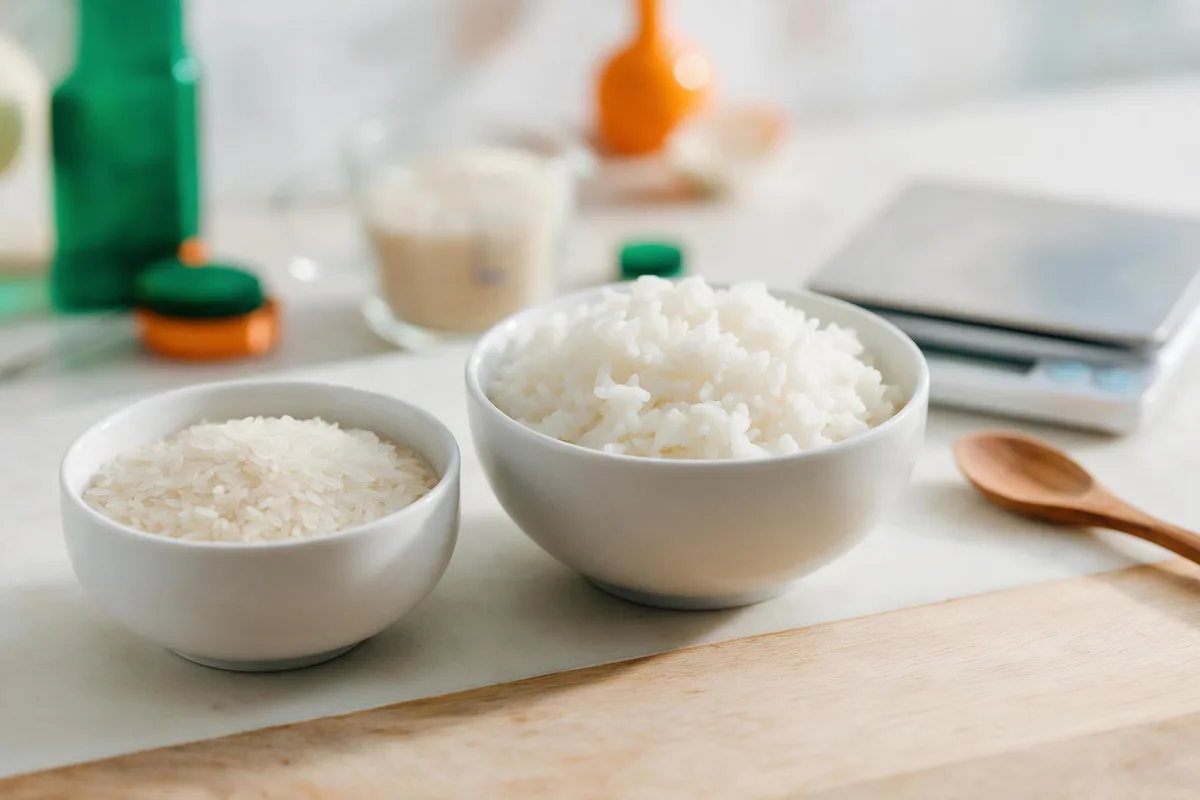
Look up rice in a food database and you will find two answers that seem to disagree. Dry white rice is 365 calories per 100 g. Cooked white rice is 130 calories per 100 g. Both are correct, and mixing them up is one of the most common ways a food log ends up hundreds of calories wrong without anyone noticing.
This post explains where the gap comes from, gives you a table for converting between the two, and shows the three habits that keep rice honest in your log. Every number comes from USDA FoodData Central, the same source behind our food pages.
Why the same rice has two calorie counts
Rice soaks up water as it cooks. The calories do not change, the weight does. According to the USDA entries, raw long-grain white rice is about 11.6 g water per 100 g, while the cooked entry is about 68.4 g water per 100 g. Most of what you spoon onto the plate is water.
So 100 g of cooked rice is a smaller amount of actual rice than 100 g of dry rice, and its calories per gram are lower. The calories in the pan before and after cooking are the same, spread over a heavier pile.
| Per 100 g, white long-grain | Calories | Protein | Carbs | Water |
|---|---|---|---|---|
| Uncooked (dry) | 365 | 7.1 g | 80.0 g | 11.6 g |
| Cooked | 130 | 2.7 g | 28.2 g | 68.4 g |
On our food pages you can see both: white rice, cooked and white rice, raw.
Rice calories by cup: a bigger gap than it looks
A measuring cup makes the trap worse, because a cup of dry rice and a cup of cooked rice feel like the same thing. They are not. From the portion sizes in the USDA entries:
- 1 cup of dry white rice is 185 g, which is about 675 calories.
- 1 cup of cooked white rice is 158 g, which is about 205 calories.
- 1 cup of cooked brown rice (medium-grain) is 195 g, which is about 218 calories.
Log a cup of cooked rice with the dry entry and you have added around 470 calories that were never on the plate. Log a cup of dry rice with the cooked entry and you have missed about the same amount in the other direction.
The original bit: converting between dry and cooked
If you weigh your rice dry, as many people do for meal prep, but your recipe or restaurant meal is described cooked, you need to translate. Using the two USDA entries above, the calories per gram differ by a factor of 365 ÷ 130, about 2.8. If cooking only adds water, 100 g of dry rice becomes roughly 281 g of cooked rice, and the calories stay at 365.
Here is that worked through for common dry portions:
| Dry rice weighed | Calories | Protein | Carbs | Roughly equals, cooked |
|---|---|---|---|---|
| 50 g | 183 | 3.6 g | 40.0 g | 140 g |
| 60 g | 219 | 4.3 g | 48.0 g | 168 g |
| 75 g | 274 | 5.3 g | 60.0 g | 211 g |
| 90 g | 329 | 6.4 g | 72.0 g | 253 g |
| 100 g | 365 | 7.1 g | 80.0 g | 281 g |
Calculated from the raw white rice entry (FDC 168877) and the cooked entry (FDC 168878). The last column is arithmetic on those two entries, not a measurement. Your own pot, rice variety and cooking time will give a slightly different cooked weight, so weigh a batch once if you want to know your own ratio.
Notice how small 75 g of dry rice looks and how generous 211 g of cooked rice looks. That is why a "normal" restaurant bowl can hold more rice than people expect.
Three mistakes, with the numbers
Here is what each of the common errors does to a log. These are the calculations behind them, so you can check them with a food scale and the rice food page.
- Weighed cooked, logged as dry. You put 150 g of cooked rice on the plate and log 150 g against the raw entry. The log says 548 calories. The plate holds 195. That is 353 calories too many. At 250 g cooked the gap is 588 calories.
- Weighed dry, logged as cooked. You weigh 75 g of dry rice, then pick the cooked entry because that is what you ate. The log says 98 calories. The real figure is 274. That is 176 calories missing from a single meal.
- Cups. As above, a cup of one is not a cup of the other. If you log by cup, know which state the cup was in.
Over a week of rice with dinner, a 176-calorie gap is 1,232 calories that the scale will eventually notice. If you are working out why a deficit is not showing up, this is a good place to look; the same checking process appears in overcoming diet plateaus.
White rice vs brown rice calories
The USDA cooked entries are 130 calories per 100 g for white long-grain and 112 calories per 100 g for medium-grain brown. Per gram of cooked rice, brown is lower, mostly because of how much water that particular cooked entry holds (73.0 g per 100 g against 68.4 g). Per cup it comes out slightly higher, because the brown-rice cup in the USDA entry weighs more.
| Cooked, per 100 g | Calories | Protein | Fibre |
|---|---|---|---|
| White, long-grain | 130 | 2.7 g | 0.4 g |
| Brown, medium-grain | 112 | 2.3 g | 1.8 g |
We have a side-by-side on the brown rice vs white rice comparison page and the brown rice food page. Two different varieties, two different cooking yields: the entries are not a like-for-like test, so treat the gap as a guide to the entry you are logging, not a rule about all brown and white rice.
How to weigh rice so the log is right
You only need one rule: decide which state you are weighing, then use the entry for that state. Practically:
- Cooking for yourself? Weigh the dry rice before it goes in the pot and use the raw entry. It is the more precise number, because you are not guessing how much water it absorbed. Our cups-to-grams converter for white rice gives the dry weight of a cup if you only have a measuring cup.
- Batch cooking for several meals? Weigh the dry rice, cook it, weigh the whole pot, and divide. If 300 g of dry rice becomes 840 g in the pot, a 210 g serving is a quarter of the pot and holds 274 calories. This is the same idea as the per-portion approach in batch cooking with AI meal plans.
- Eating rice you did not cook? Weigh it cooked, use the cooked entry, and remember that rice from a takeaway is often cooked with oil or salt, so the plain entry is a floor, not a promise. Our eating-out guide covers the rest of the plate.
- No scale? Log the cooked entry by the cup and accept the error. A fist-sized pile of cooked rice is a rough guide, not a measurement. Photographing the plate and letting the AI food scanner estimate the portion, then correcting the weight if you know it, is a fair compromise.
Where rice fits in your day
Rice is a carbohydrate-heavy, low-fat, low-protein food, which is why it pairs well with a protein you have already planned. A 200 g cooked portion is 260 calories and about 5 g of protein; the protein has to come from the rest of the plate. If you want to see how much protein your day needs, the protein calculator will give you a range from your weight and goal.
To see how a rice portion sits inside your daily budget, try the calculator below.
Common questions
Is it 365 or 130 calories per 100 g of rice?
Both, for different things. 365 is the figure for 100 g of dry rice, and 130 is for 100 g of cooked rice. Pick the one that matches what you weighed.
How many calories are in a cup of cooked rice?
For white long-grain rice, about 205 calories, using the USDA cup of 158 g. A cup of cooked medium-grain brown rice is about 218 calories at 195 g. A cup depends on how tightly the rice is packed, so a scale is more reliable.
Should I weigh rice before or after cooking?
Before, if you can. The dry weight is stable, while the cooked weight depends on how much water the rice absorbed. After cooking works too, as long as you use the cooked entry.
Does rinsing or draining change the calories?
We have not found a USDA entry that measures it, so we will not guess a number. If you drain a lot of cooking water, your cooked weight changes, which is another reason to weigh dry.
Does leftover or reheated rice have fewer calories?
We cannot answer that from our data, so we do not claim it. Weigh what you eat and log it as cooked rice.
The short version
Dry rice is about 2.8 times as calorie-dense as cooked rice by weight, because cooked rice is mostly water. Weigh the state you are logging, log with the matching entry, and keep a cooking ratio if you batch cook. It takes ten seconds and removes a mistake that can add or hide several hundred calories in a single meal.
Want rice logged without the guesswork? Start tracking free and snap the plate; adjust the weight if you know it.
Sources
This is general information, not medical advice. If you are pregnant, under 18 or managing a health condition, talk to a doctor or registered dietitian before changing how you eat.
New guides by email, once a month
At the start of each month we send one email listing what is new on CalorTracker: blog posts, food pages and calculators. That is the only email this sign-up sends.
Have a CalorTracker account? If you agreed to email updates when you set it up, this email already comes to you, and signing up here as well still sends it once.
More from the blog
 Peanut Butter Calories: Why It Is the Most Under-Logged Food (and How to Fix It)A level tablespoon of peanut butter is about 96 calories; a big spoon can be three times that. The arithmetic and how to log it.CalorTracker Team · 7 min read
 Overcoming Diet Plateaus: The Hidden Macros You're MissingHit a wall in your weight loss journey? Discover the sneaky hidden macros and calorie leaks that are sabotaging your progress.CalorTracker Team · 8 min read
 How Much Fiber Per Day? Portions That Add Up to 25 gWhat the WHO says about daily fiber, the fiber in sixteen everyday portions worked out from USDA data, and two sample days that reach 25 g, calories counted.CalorTracker Team · 8 min read
Track what you eat without the typing
Snap a photo, say what you ate or type it, and CalorTracker's AI estimates the calories and macros for you to check. Free to start, no card needed to explore.
Start free on the web