Track Your Nutrition with AI
Snap a photo, track macros, and crush your goals instantly.
Snap a photo, track macros, and crush your goals instantly.
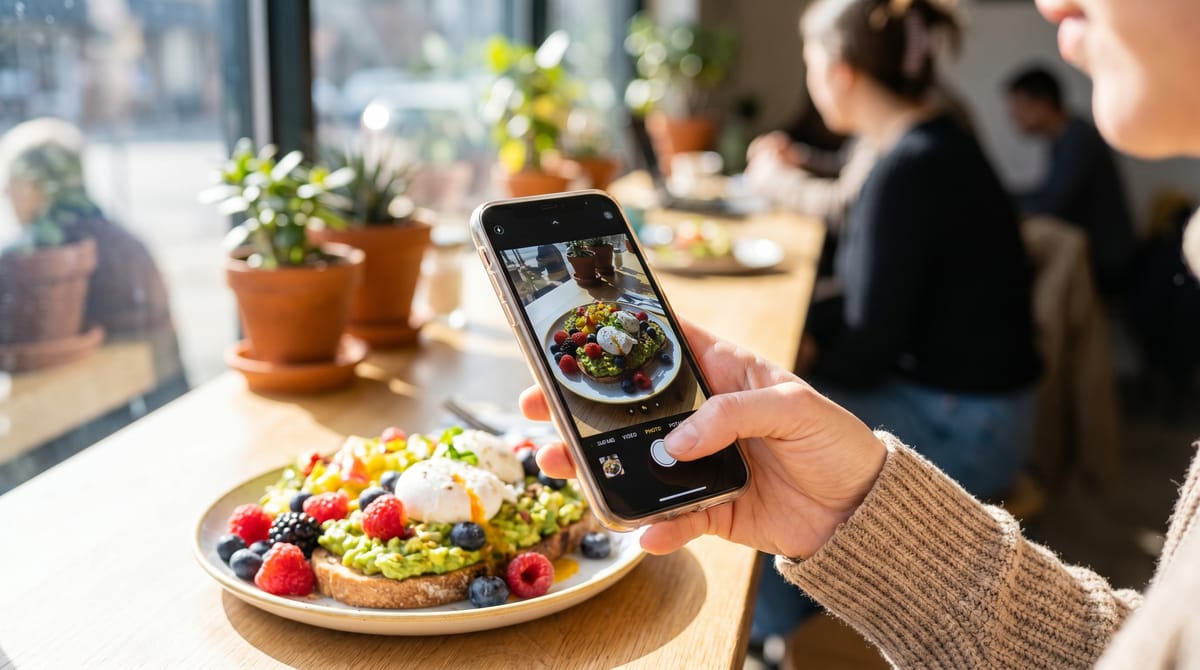
It is the first question everybody asks before installing a photo-based food tracker, and it deserves a straight answer rather than marketing.
A photo estimate is very good at identifying what is on the plate, decent at portion size, and weakest on the things it cannot see. That is the whole truth in one sentence. The rest of this article is about which parts of your dinner fall into which category - and how to close the gap in about five extra seconds.
Modern vision models are excellent at the job that used to eat your time: recognition. Chicken thigh versus chicken breast. Basmati versus risotto. That the green thing is broccoli, and that the sauce on it is not just water.
They are also better than people expect at relative portions, because a plate is a ruler. A standard dinner plate is 26-28 cm across, a fork is about 19 cm, a chicken breast has a familiar shape and thickness. From that, an estimate of "roughly 150 g of rice" is usually closer than the number a human would type in - the classic human error is eyeballing 220 g of pasta and logging 100 g because that is what the packet calls a serving.
And they are consistent, which matters more than it sounds. We will come back to that.
Be sceptical of anyone who claims otherwise. These are the real failure modes:
The usual test - "the app said 620, the scale said 540, therefore the app is bad" - measures the wrong thing.
The honest comparison is not photo estimate versus weighed ideal. It is photo estimate versus what you would otherwise have logged, which in practice is one of three things:
Against options one and two, a photo estimate is a clear upgrade. Against option three it is behind, and that is exactly why CalorTracker still lets you type an exact weight or scan a barcode whenever you want to.
Worth remembering too: the "accurate" numbers are estimates as well. Packaged food labels carry a permitted tolerance rather than being exact to the calorie, and a generic database entry for "chicken breast, cooked" is an average across birds, cuts and cooking methods. There is no perfectly true number to be measured against - only better and worse estimates.
This is the part that should change how you think about tracking.
Suppose your logging is consistently 10% low. Your app says 1,800, you actually ate 2,000. Does the plan fail?
No - because you do not act on the calorie number. You act on what the scale does over four weeks. If your trend line is flat at a logged 1,800, you drop to a logged 1,600 and it moves. The bias cancels out, because both readings were taken with the same crooked ruler.
What ruins a plan is inconsistency: weighing everything on Monday, eyeballing on Friday, logging nothing on Sunday. Then the trend and the log tell different stories and you cannot work out which to trust.
A photo estimate is a systematic, repeatable ruler used seven days a week. That is worth far more than a perfect ruler used four days out of seven. Pair it with the weight trend and pace verdict and you have a feedback loop that survives any fixed bias in the log.
Try it on your next meal - photograph the plate, watch it break down into foods and macros, and adjust anything that looks wrong. Free to start.
Photo logging is the right default for the other 95% of life, but weigh your food when:
AI calorie counting is not a laboratory instrument, and no honest app should tell you it is. It is a fast, repeatable estimate that removes the friction that kills most food diaries in week two - and an estimate you actually record every day is worth far more than a precise one you abandon.
Use the photo for speed, the barcode for packets, the description box for hidden fats, and the four-week weight trend as your source of truth. That combination is more accurate, in practice, than any method you will still be using next month.
See how the scanner works on the AI food scanner page, or read why AI beats a search box if you are coming from a traditional tracker.
Snap a photo of your meal and let CalorTracker's AI log the calories and macros for you.
Start Tracking Free